


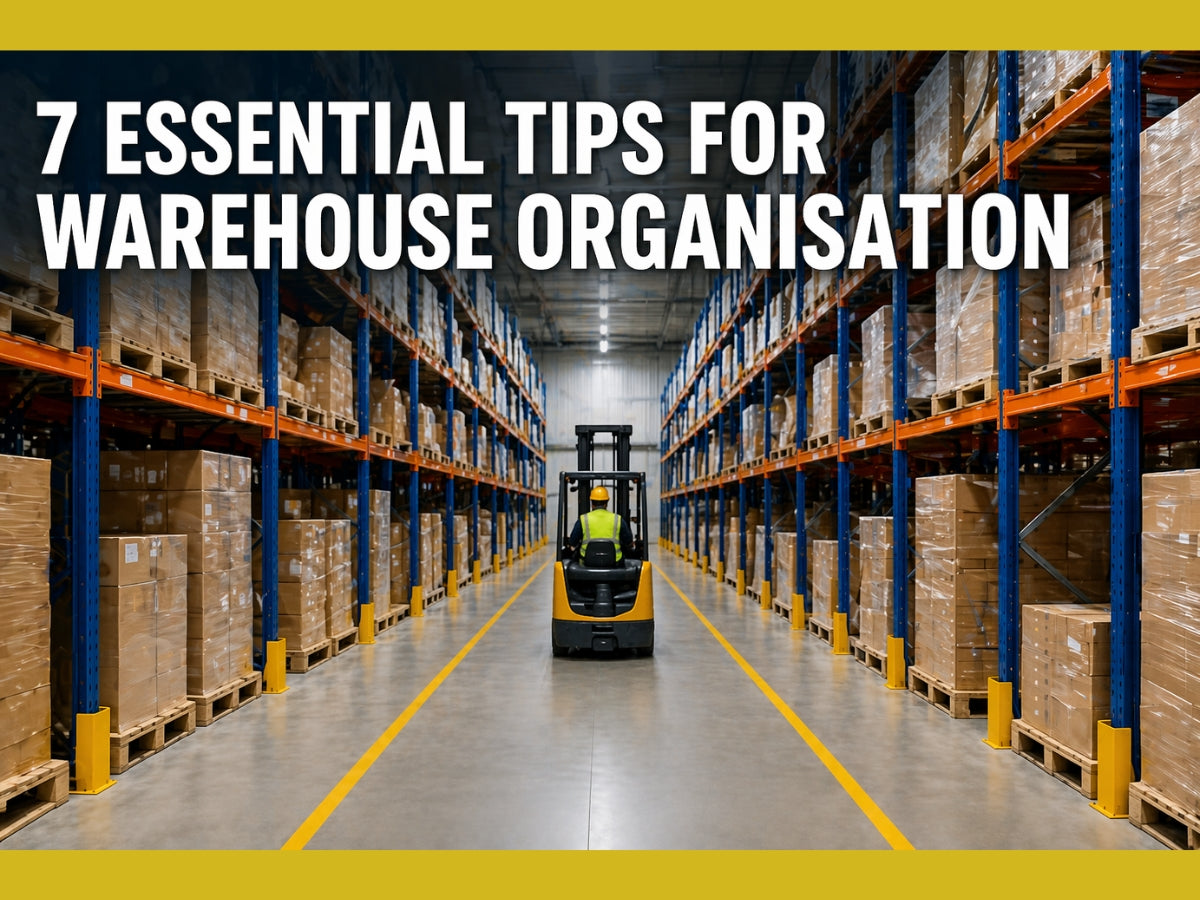
Why Warehouse Organisation Fails in Practice
Disorganised warehouses don't fail quietly — they bleed time, inflate labour costs, increase picking errors, and create avoidable safety risks. At Cracking Racking, this is the most common issue we see on warehouse floors across Greater Manchester and the wider North West: teams spending more time searching for stock than moving it.
Warehouse organisation breaks down when storage decisions are made reactively instead of operationally. Racking layouts, aisle widths, and stock locations often reflect past volume — not current demand, SKU velocity, or picking behaviour.
The good news is that most warehouse organisation problems can be fixed without buying more racking. The 7 warehouse organisation tips below are field-tested across UK distribution operations — start with the first three and you'll see measurable improvement within weeks.
1.Design Your Layout Around Movement, Not Storage Capacity
The most common warehouse organisation mistake in the UK is optimising for maximum pallet positions while forgetting how goods actually move. A warehouse packed with pallet racking systems is useless if your fastest-selling stock sits 60 metres from the dispatch zone.
- Map inbound → storage → pick → dispatch routes before touching your layout
- Place fast-moving SKUs closest to pick and dispatch zones
- Avoid long cross-warehouse travel for daily picks
- Design aisles wide enough for your material handling equipment
Before repositioning any racking, conduct a simple time-and-motion study during a normal pick shift. Walk the floor with a stopwatch. You'll quickly see where travel time accumulates and where congestion forms.
2.Apply ABC Slotting Based on Picking Frequency
Equal space allocation is one of the most expensive warehouse organisation mistakes a UK business can make. Applying ABC slotting to your inventory — categorising stock by picking frequency — is one of the highest-return changes you can make without purchasing a single new rack.
| Tier | Frequency | Storage Location | Rack Height |
|---|---|---|---|
| A-Items | Picked daily / multiple times per day | Front-facing, closest to dispatch | Eye-to-waist height |
| B-Items | Picked weekly | Standard pallet racking zones | Mid-level bays |
| C-Items | Picked monthly or less | High-level or deep storage | Top bays or back zones |
Result: Reduced picker fatigue, faster order turnaround, and fewer access conflicts. Most UK warehouses that implement ABC slotting see a measurable reduction in pick times within the first two weeks — without adding staff or racking.
3.Standardise Location Labelling — No Exceptions
If your warehouse relies on "tribal knowledge" — where experienced staff know where things are but new operatives don't — your operation is already vulnerable. One person leaving can expose an entire location system as informal and undocumented.
- Use a consistentAisle – Bay – Level – Positionformat across every location
- Labels must be readable from a picking distance (minimum 50mm character height)
- Match physical labelsexactlywith WMS or spreadsheet records
- Use colour-coded labels for different product zones or temperature requirements
4.Use Vertical Space Intentionally (Not Randomly)
Unused vertical space is wasted capital — but poorly used height creates serious safety risk. The goal isn't to stack as high as possible; it's to match the right stock type to the right height based on frequency, weight, and access method.
For bulk items and slow-moving pallets, high-level storage using tall pallet racking systems makes excellent use of available height. For mid-weight items that don't require full pallet positions, longspan shelving provides flexible, accessible storage at a lower cost per bay.
- Store slow-moving or bulk pallets at height — use forklift-accessible bays
- Keep high-turn SKUs at accessible levels (waist to eye height)
- Ensure racking load ratings match your actual pallet weights
- Never overload beams — mix pallet types only after proper load assessment
5Separate Picking Stock from Bulk Storage
Mixing reserve stock and active pick faces is one of the most common causes of warehouse congestion. When replenishment happens during active picking windows, pickers and forklift operators compete for the same aisles — creating delays, safety risks, and picking errors.
- Maintain dedicated forward pick locations, separate from bulk reserve
- Replenish pick faces from bulk storage during off-peak hours (early morning or overnight)
- Never replenish during active picking windows — schedule it around order cut-off times
- For oversized or irregularly shaped bulk stock, cantilever racking provides the most accessible bulk storage option
UK Distributor — Two-Zone System Implementation
A mid-size UK distributor reduced pick delays significantly by reorganising into a two-zone system — bulk pallets stored centrally, pick faces located near dispatch. Picking accuracy improved immediately, without additional staff or new racking. The change took one weekend to implement using their existing racking layout.
6.Audit and Remove Dead Stock Relentlessly
Obsolete stock quietly consumes prime storage space. It's common to find 15–20% of a warehouse's most accessible racking positions occupied by products that haven't moved in six months or more. That's your most valuable pick-face space being used as a storage museum.
- Review stock that hasn't moved in 6–12 months on a monthly schedule
- Sell, recycle, return to supplier, or isolate dead inventory into a designated zone
- Never allow slow stock in high-access zones — every accessible bay should earn its location
- If you're clearing significant racking space, consider used racking and shelving to cost-effectively expand your pick face
7.Build Organisation into Daily Operations
Organisation fails when it's treated as a one-time project. The most efficient UK warehouses treat layout and location accuracy as operational maintenance — an ongoing discipline, not a clean-up exercise carried out once a year.
- Assign zone ownership to named supervisors — accountability drives consistency
- Include location accuracy checks in daily operational checklists
- Schedule monthly racking and layout reviews — look for drift from the intended system
- Review ABC slotting classifications quarterly as product mix and velocity change
Common Warehouse Organisation Mistakes to Avoid
Knowing what not to do is just as important as the tips above. These are the most frequent warehouse organisation mistakes we see in UK operations — most are easy to fix once identified.
-
Assuming more racking solves the problem. Over-racking restricts movement, narrows aisles, and increases handling steps. The right amount of racking is the amount that supports safe flow — not maximum density.
-
Not reviewing slotting after a product range change. Your ABC classifications become outdated the moment a new product line launches or a seasonal promotion begins. Review at every major change.
-
Using informal label systems. Post-it notes, hand-written bay markers, and verbal-only location names create a dependency on specific staff. If it isn't formally labelled and documented, it isn't really a system.
-
Replenishing during active picking. This is the single biggest cause of aisle congestion and picking errors in busy UK warehouses. Schedule replenishment around your operation, not through it.
-
Skipping the racking safety assessment. Damaged uprights, bent beams, and overloaded bays are common in warehouses that haven't been formally inspected. Always assess before reorganising.
Ready to Put These Tips Into Action?
Our Manchester-based team can survey your current warehouse layout, recommend the right racking configuration, and handle full installation across Greater Manchester and the North West.
Get a Warehouse Quote →Or call us directly: 0161 330 1164Your Next Practical Step
Before investing in new racking or software, walk your warehouse during peak picking hours. Track where time is lost, where congestion forms, and where decisions slow movement. These observations reveal whether your existing industrial racking systems are supporting efficient flow — or creating hidden bottlenecks.
Fix those friction points first. Organisation follows operational clarity, not the other way around. For a deeper look at maximising what you already have, read our guide on how to increase warehouse storage space.
When you're ready for a physical solution — whether that's reconfiguring your current layout, adding pallet racking, or sourcing used racking to expand cost-effectively — professional racking installation in Manchester from our team ensures everything is configured safely and efficiently from day one.
Serving Warehouses Across Greater Manchester & the North West
Cracking Racking is based in Greater Manchester and supplies and installs pallet racking, longspan shelving, and cantilever systems across Manchester, Oldham, Salford, Bolton, Rochdale, Bury, Wigan, and the wider North West. Whether you're implementing these warehouse organisation tips from scratch or upgrading an existing system, our local team is ready to help. Call 0161 330 1164 or contact us online.